
| Home | Open Account | Help | 499 users online |
|
Member Login
Discussion
Media SharingHostingLibrarySite Info |
European Railroad Discussion > Austria's Kalte Rinne Viaduct renewed and gets a faceliftDate: November 01, 2026 03:08AM Austria's Kalte Rinne Viaduct renewed and gets a facelift Author: railsmith The crown jewel of the line over Austria’s Semmering Pass, Kalte Rinne Viaduct has had a complete facelift to complement its structural renovation, even though the route it serves will soon be bypassed by a high-speed tunnel.
Prior to my recent trip to Austria, I posted a request for information on progress in restoring the viaduct. I wanted to see this magnificent bridge in person, but was not encouraged by photos of it taken in the spring that showed it completely obscured by scaffolding and protective shrouds. My posting drew more than 400 views, but not a single reply, so I was in the dark when I set out from Vienna on October 3 to see for myself. Fortunately, I found that much of the restoration had been completed, so my trip was not in vain and I had an interesting and productive day. Rehabilitation of the viaduct’s railway infrastructure (new concrete deck, roadbed, track, catenary) had been completed in late May, following 11 weeks of single-track operation. Double-track operation was in full swing for my visit, with international, intercity, regional and local passenger trains mixing with intermodal and general freight trains in a steady flow. That won’t be the case after the new 27.3-km Semmering Base Tunnel opens between Gloggnitz and Mürzzuschlag in late 2029 (current estimate), allowing speeds of up to 230 km/h (143 mph). That will see all traffic except the infrequent local passenger trains rerouted through the new bore, shaving 30 minutes off their journeys. With more than 150 movements daily taking the new route, the classic line over the pass will be quiet. Despite the drastic drop-off in traffic, the current investment in Kalte Rinne Viaduct and other infrastructure on this line (20 million euros in this year alone) will ensure that the classic route over the pass is available when needed for diversions. Some quick facts. The railway over Semmering Pass was built from 1848 to 1854 under the direction of Carl Ritter von Ghega, a prodigy who earned his engineering designation at the age of 16 and his doctorate in mathematics a year later in 1819. Before attempting to build the line, he visited North America to study the early mountain railways on that continent and concluded that the same could be done in Europe. The resulting project employed 20,000 workers, using basic manual techniques in this era before dynamite, and more than 1,000 died in the effort. In 41.8 km, the line has 16 viaducts and 15 tunnels, more than 100 other bridges, and a ruling gradient of 2.5%. It’s considered to be Europe’s first standard-gauge mountain railway. Built from 1850 to 1853, Kalte Rinne Viaduct has five lower arches supporting 10 arches on its second tier, and stretches 184 metres end to end. It forms the apex of a 10-degree horseshoe curve. The line sits 46 metres above the valley floor, on a 1.7% gradient toward the summit that lies farther to the south in the middle of the original 1.4-km Semmering Tunnel. During my visit, I wondered aloud why the extensive cosmetic work on the viaduct’s facade was undertaken, but the European railfans I spoke to that day pointed out that the whole route has been designated as a World Heritage Site by UNESCO, which obliges its owner to maintain the line’s heritage characteristics. Now for some photos on a fine sunny Saturday just two weeks into autumn. (1) A 25-minute walk from Breitenstein station got me to the site of the viaduct. Most of the restoration work on the concave east face had been completed, and there’s not too much construction equipment in the scene. (2) In the tight confines, it’s hard to get a full view of the viaduct. Here, seven of the upper arches are visible, but the lower tier is obscured by vegetation. The building at upper left is a former sectionman’s house, now the Ghega Museum of the line’s history. It was closed when I was there, but I’ve seen on a TV show that it houses a large model of the viaduct. (3) Even at this height, not much can be seen of a passing train. In this view, three OBB electric locomotives lead a northbound mixed freight. Edited 6 time(s). Last edit at 11/01/2026 08:14PM by railsmith. 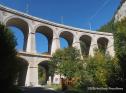 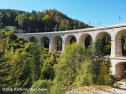 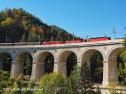 Date: November 01, 2026 03:10AM Re: Austria's Kalte Rinne Viaduct renewed and gets a facelift Author: railsmith (4) It’s when you stand at the base that the viaduct’s dimensions make a real impression. Here, I’m looking up at the east face from ground level, at the mid-point of the concave arc.
(5) Views of the convex west face from public property are more limited, as the road is lined with trees on its north side. On this face, some scaffolding and ladders are still in place, but might be gone by the time this is posted. (6) The southern end of the west face is seen here. Once again, standing close to the viaduct at ground level gives a sense of its dimensions. Edited 1 time(s). Last edit at 11/01/2026 03:27AM by railsmith. 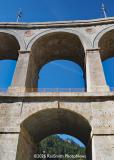 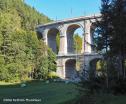 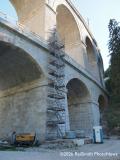 Date: November 01, 2026 03:12AM Re: Austria's Kalte Rinne Viaduct renewed and gets a facelift Author: railsmith (7) At ground level beside the road, the final touches of the restoration were in progress. A facing stone has been placed at lower left, with the gap still to be filled, and the space for another can be seen at right.
(8) Now we’re at track level at the southern end, looking north toward the 337-metre Polleroswand Tunnel that runs through the mountain of the same name. Note the freshly restored stonework. (9) More evidence of the restoration is seen in the renewed parapet wall on the viaduct’s east side. For the project, the 1,890 stones that form the parapet walls were removed to allow access. Each stone was numbered for eventual replacement in precisely the same location. This was necessary because this type of stone is no longer available from local quarries, so using replica stones was not an option. The stones were cleaned while in storage at a stonemason’s yard. Edited 2 time(s). Last edit at 11/01/2026 08:13PM by railsmith. 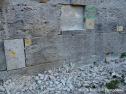 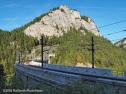 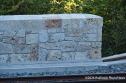 Date: November 01, 2026 03:15AM Re: Austria's Kalte Rinne Viaduct renewed and gets a facelift Author: railsmith (10) Even at track height, the angles for train photography are limited. Better views can be gained by hiking up the side of the Pollereswand, as in this 1957 shot displayed on an information sign. This northbound train is about to enter the tunnel. The line was electrified in the following year.
For a superb view from the very top of the Polleroswand, see pages 32-33 of the May 2017 issue of Trains magazine, taken in predawn light. The article is an excellent source on this subject. (11) OBB 1116 241 leads southbound Railjet train RJ 858 (14:02 Vienna Airport -- Villach) across the viaduct. (12) Owned by a leasing company, Siemens Vectron locomotive LLPX 193 206 runs south on a light engine movement. Edited 4 time(s). Last edit at 11/01/2026 06:00AM by railsmith. 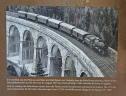 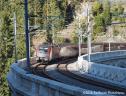 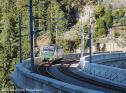 Date: November 01, 2026 03:18AM Re: Austria's Kalte Rinne Viaduct renewed and gets a facelift Author: railsmith (13) Photography is easier from the south end of the nearby Krauselklause Viaduct, which sits at the north end of the Polleroswand Tunnel. To reach it, I walked for about five minutes up the path after taking photo 2.
From ground level, overall views of this viaduct are obscured by foliage, so this painting made soon after its completion will have to suffice. The three lower arches support six on the upper tier. (14) The 84-metre long viaduct is seen from the road on the valley floor, in this view looking compass northwest. (15) OBB 1144 216 leads southbound Intercity train IC 535 (11:53 Vienna -- Graz). It has just passed through the 13.5-metre Krausel Tunnel, the shortest on the Semmering line, which functions essentially as a protective rockshed. Edited 4 time(s). Last edit at 11/01/2026 03:35AM by railsmith. 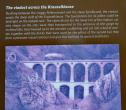 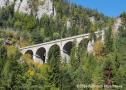 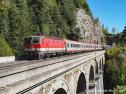 Date: November 01, 2026 03:22AM Re: Austria's Kalte Rinne Viaduct renewed and gets a facelift Author: railsmith (16) OBB 1116 229 heads southbound Railjet train RJ 110 (13:24 Vienna -- Munich via Villach). That’s the long-way round to Munich – 8 hours, 15 minutes end to end (roughly double the direct route). Passengers will appreciate the 30-minute time-saving with the new base tunnel .
(17) This northbound Railjet service is formed with a České dráhy (Czech Railways) ComfortJet consist, which was headed by an OBB Class 1216 locomotive. The train is RJX 56 (11:33 Villach-Prague). Another long trip -- just short of eight hours. (18) OBB 4746 111 crosses northbound on R91 7518 (13:09 Mürzzuschlag -- Payerbach-Reichenau). The same unit will shuttle back and forth between those end points all day, leaving from each end every two hours on a journey that takes 43 minutes and serves eight intermediate stations. This is the main service that will continue after the base tunnel opens, greatly reducing the variety for photographers. That leaves three years to enjoy the daily parade of trains through this world heritage site. I hope to be back for it. Edited 2 time(s). Last edit at 11/01/2026 09:04AM by railsmith. 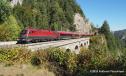 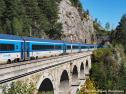 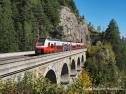 Date: November 01, 2026 03:32AM Re: Austria's Kalte Rinne Viaduct renewed and gets a facelift Author: GPutz Thanks for the pictures and information. Gerry
Date: November 02, 2026 09:14AM Re: Austria's Kalte Rinne Viaduct renewed and gets a facelift Author: NMlurker Nice coverage. Enjoyed it.
Date: November 02, 2026 10:12AM Re: Austria's Kalte Rinne Viaduct renewed and gets a facelift Author: SOO6617 Thank you for the excellent photographs of these gorgeous viaducts.
Date: November 03, 2026 03:42AM Re: Austria's Kalte Rinne Viaduct renewed and gets a facelift Author: march_hare Great pics and news report.
Date: November 03, 2026 08:31AM Re: Austria's Kalte Rinne Viaduct renewed and gets a facelift Author: PasadenaSub Excellent group of photos and coverage of the history of the area.
Rich |